
Lehigh County Court Records After Arrest
After an arrest in Lehigh County, the custody record and the court record split. The Lehigh County Jail can route custody, records, mail, medical, and visiting questions, while the Pennsylvania courts show the formal criminal case. The court record is where charges, grading, statute citations, bail entries, preliminary hearings, criminal information filings, dispositions, and sentence entries appear. That distinction matters when a family member knows someone was booked but cannot yet find the full charge history.
The Lehigh County District Attorney is the local prosecutor for county criminal cases. The District Attorney's Office is located in the county courthouse and decides how charges proceed after police file or initiate the first papers. A booking charge may reflect the arresting agency's first allegation. Later, a prosecutor may approve it, reduce it, add a count, withdraw it, or move it into Common Pleas by criminal information. For custody and intake details, use Lehigh County jail inmate records; for photo questions, use Lehigh County jail mugshots.
Find Lehigh County Court Records After Arrest
The starting point for court records after a Lehigh County arrest is the Pennsylvania UJS Case Search. The UJS case information page says public web docket sheets cover Pennsylvania appellate courts, criminal courts of common pleas, magisterial district courts, and Philadelphia Municipal Court. For a fresh Lehigh County arrest, check magisterial district dockets as well as Common Pleas, because preliminary arraignment and preliminary hearing entries may appear before a case is held for court.
The UJS Case Search page is the official search screen used for Pennsylvania criminal docket sheets.
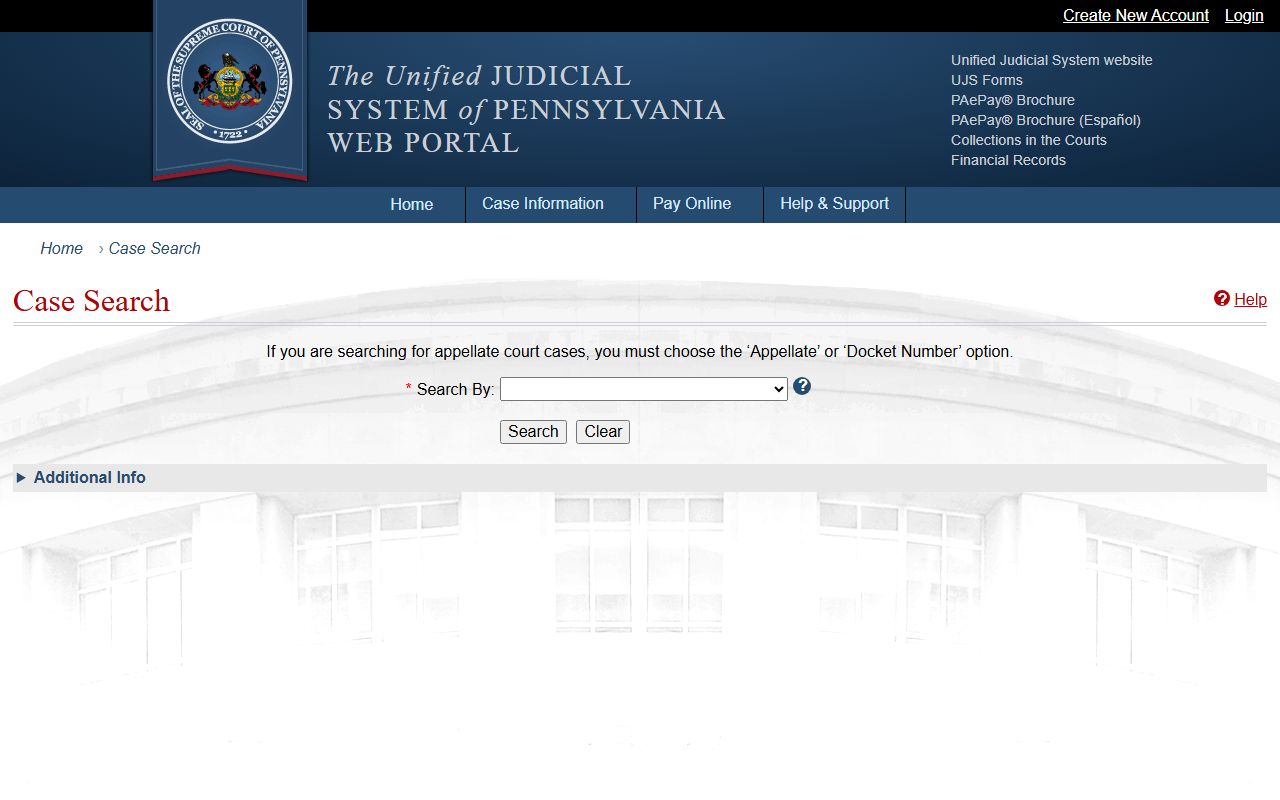
Use the strongest identifier available. An OTN, docket number, complaint number, or SID can narrow results faster than a common name search.
| UJS Field | Type | Required | Lehigh County Use |
|---|---|---|---|
| Case Number | Text | Optional | Best when copied from court paperwork or a docket sheet. |
| Participant Name | Text | Optional | Use the defendant's full legal name; filter common names with court type or county. |
| Organization Name | Text | Optional | Usually not the main field for a jail arrest search. |
| Offense Tracking Number | Text | Optional | A strong bridge from police or booking paperwork to the docket. |
| Police Incident or Complaint Number | Text | Optional | Helpful when the arresting agency supplied a complaint number. |
| State ID Number | Text | Optional | Useful when a criminal justice SID is known. |
- Gather the full name, date of birth, arrest date, police department, docket number, OTN, complaint number, citation number, or SID.
- Search UJS by participant name first, then repeat the search by OTN or docket number if paperwork gives one.
- Open both magisterial district and Common Pleas results when they appear, since early and later case stages can be in different docket tracks.
- Read the docket sheet for charges, grading, bail action, hearing dates, disposition, and sentence entries.
Lehigh County Arrest Charging Documents
A Lehigh County arrest can begin with police custody and booking, but the court record takes shape through charging documents. A criminal complaint is often the first court-facing paper. The preliminary arraignment sets early release terms and dates. If charges are held for court or waived past the preliminary stage, the District Attorney may file a criminal information in the Court of Common Pleas. Grand jury indictments are possible in specific cases, but routine county prosecutions most often move through complaint and information.
| Document | Who Files It | Where It Appears | What It Means |
|---|---|---|---|
| Criminal complaint | Police or prosecutor | Often magisterial district court | Starts or supports the first formal charge record after an arrest. |
| Criminal information | District Attorney | Criminal Court of Common Pleas | Formal charging paper after charges are held for court or waived. |
| Indictment | Grand jury process | Case-specific court file | Used in particular matters, not the default path for most county cases. |
The Clerk of Judicial Records Criminal Division is the local office for criminal records counter questions. The research identifies Michelle Graupner as Clerk of Judicial Records and places the Criminal Division in Room 122 of the Lehigh County Courthouse. Its phone number is 610-782-3077, and the listed hours are 8:00 a.m. to 4:30 p.m., Monday through Friday, subject to court holiday closures.
Lehigh County Charge Status Records
Charges can change after booking. A jail booking entry may be based on the arresting agency's first information, while court records show what the court and prosecutor do next. The UJS docket may list preliminary hearing results, withdrawn counts, amended charges, pleas, verdicts, sentences, and dismissal entries. Read each count on its own. One charge can be dismissed while another remains pending or ends in a plea.
| Status | Plain Meaning | What to Check |
|---|---|---|
| Pending | The charge has not reached final disposition. | Next hearing, bail action, and case calendar. |
| Held for court | The charge moved from preliminary stage toward Common Pleas. | Common Pleas docket and criminal information filing. |
| Amended or reduced | The filed charge changed in level, wording, statute, or count. | Original charge, amended charge, and date of change. |
| Withdrawn or dismissed | The charge is no longer being pursued in that form. | Whether any other counts remain active. |
| Nolle prosequi | The prosecutor decided not to pursue a charge. | Court order or docket entry tied to that count. |
| Disposed | The charge has a final result, such as plea, verdict, dismissal, or sentence. | Disposition date and sentence fields. |
Lehigh County Bail Records
Bail is part of the court record after a jail arrest, but it is not the same as a roster entry. UJS may show bail action, amount, and conditions. Lehigh County sources also point to jail general information at 610-782-3270, jail records at 610-782-3263, and the Clerk Criminal Division at 610-782-3077 for court filing or payment questions. The official research found that Lehigh County links an after-hours bail procedure PDF, but exact payment methods were not extractable in text, so card, cash, kiosk, or online-payment claims should be confirmed with the office before funds are brought.
| Bail Type | How It Works | Lehigh County Checkpoint |
|---|---|---|
| Release on recognizance | Release based on a promise to appear and obey conditions. | Read the docket for nonmonetary terms. |
| Unsecured bail | No upfront deposit, but money may be owed after a violation. | Confirm conditions and next court date. |
| Cash or percentage bail | The court may require a deposit or cash amount. | Call the jail or Clerk before bringing funds. |
| Surety bond | A bail bond agency or surety may be involved. | The inmate guidelines say bail agency lists are posted inside the jail. |
| No-bail or hold | A detainer, warrant, parole hold, federal hold, or other order can block release. | Check all dockets and custody agencies. |
Note: A person can have bail on one Lehigh County case and still remain held because of a detainer, warrant, state sentence, federal matter, or immigration hold.
Lehigh County Arrest Warrants
The Lehigh County Sheriff's Office is not the jail operator, but it has a key warrant role. The official Sheriff's Office page lists Sheriff Joseph N. Hanna and describes duties that include serving court documents, transporting prisoners, providing court security, and investigating fugitives and bail jumpers. The materials reviewed did not locate a public searchable active-warrant database for Lehigh County.
The Sheriff's walk-in bench warrant instructions say defendants must surrender to the Sheriff's Office by 9:00 a.m. to be processed for an 11:00 a.m. bench-warrant hearing. Missing that deadline moves the hearing to the next business day. Warrant questions can involve UJS docket entries, the Sheriff's Office at 610-782-3175, Criminal Division records, and the county Right-to-Know process. Search warrants are different. They authorize a search and are not an inmate lookup tool.
Lehigh County Charges vs Convictions
Being arrested and charged in Lehigh County is not the same as being convicted. A charge is an accusation in a court case. A conviction requires a guilty plea, verdict, or other qualifying final result. UJS docket sheets are useful for reading public court events, but Pennsylvania courts warn that docket sheets should not replace a Pennsylvania State Police criminal-history background check.
| Point | Charge | Conviction |
|---|---|---|
| Stage | Filed accusation after arrest or complaint review. | Final result from plea, verdict, or qualifying court action. |
| Proof level | May begin with probable cause or charging review. | Requires the legal standard for guilt or an accepted plea. |
| Can change | May be amended, reduced, withdrawn, or dismissed. | May be followed by sentence, appeal, sealing, or expungement steps. |
| Where checked | UJS docket, complaint, information, and Clerk records. | UJS disposition fields and official PSP PATCH record checks. |
Sealed and Expunged Arrest Records
Pennsylvania access rules do not mean every court record after a Lehigh County arrest stays visible in the same way forever. Some juvenile, sealed, expunged, investigative, victim, medical, security, and personal-identifier records can be restricted. The Pennsylvania Right-to-Know Law creates the general agency-record request framework, but it also contains exceptions. Criminal history dissemination is also controlled by Pennsylvania CHRIA.
| Record Action | Public Visibility | Practical Effect |
|---|---|---|
| Sealed or limited access | Hidden from ordinary public view, subject to the order and law. | Some agencies or courts may retain limited access. |
| Expunged | Removed or destroyed as ordered by the court. | Record-specific questions go to the court or agency that controls the record. |
| Dismissed but not expunged | May still appear unless a separate sealing or expungement process applies. | Check the docket and seek case-specific legal advice if needed. |
| Juvenile or protected record | Often restricted by law. | Do not expect ordinary UJS or RTK access. |
PATCH and UJS Records
UJS docket sheets and Pennsylvania Access To Criminal History, known as PATCH, serve different purposes. UJS is a free public docket search for court activity. PATCH is the Pennsylvania State Police channel for statewide criminal history record checks. A person reviewing court records after an arrest can use UJS to follow the local case path, but employment, tenant, licensing, credit, insurance, and other regulated screening questions require proper FCRA-compliant processes and official criminal-history channels.
Important: Public docket research is not a consumer report and should not be used for FCRA-covered screening decisions.
Older Lehigh County Court Records
Older or hard-to-match records may require direct contact with the Clerk of Judicial Records Criminal Division or an in-person records counter request at the courthouse. The Lehigh County Court of Common Pleas is at 455 West Hamilton Street in Allentown, the same courthouse complex that houses the DA, Clerk, and Sheriff's Office. If the record sought is not a court docket but a county agency record, the Lehigh County Right-to-Know page routes requests to Open Records Officer Sheila Dutra-Michel at OpenRecords@lehighcounty.org, with mail, drop-off, and fax options.
Right-to-Know requests should be specific and concise. Lehigh County repeats the Pennsylvania five-business-day response rule and notes that a 30-day extension may be invoked. Copies are listed at 25 cents per page, and advance payment is required when copying fees exceed $100. Criminal investigative limits, CHRIA, victim protections, juvenile rules, security concerns, medical privacy, and personal identifiers can affect what gets released.